Showing posts with label mentor text. Show all posts

Friday, June 10, 2022

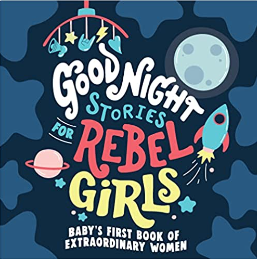
Good Night Stories for Rebel Girls: Baby's First Book of Extraordinary Women


My Thoughts:

I know this is a board book on a middle school/YA blog, but I also have never had girls in my family until my son and his wife had our first granddaughter 18 months ago. There are 3 sons and 3 grandsons that came before her. Suddenly, the responsibility has shifted so I have been reading more female empowering books, including this one.

But it fits in this blog because of its potential to be used in the middle school classroom. When I taught 8th grade, we would have a partnership with the primary grade teachers (K-2) for our 7th and 8th graders to come and do read alouds. We could work with our students on prosody in reading to engage and the primary students would have a big brother or big sister in the school. By 8th grade, though, it was also about creating these stories, or more accurately, taking their historical research in 8th grade social studies and their research in the genre of children's literature in English and starting to write their own stories.

This is a great model text for that activity. The implications for student learning using this book as an example has to do with doing enough reading nationally and internationally to choose the small amount of women for a picture book. In short:

  1. Who should be chosen?
  2. Who should get a 2-page spread versus one page? Why?
  3. What is the balance between America and the international?
  4. What different kind of impact will be chosen?
  5. How do you define a "rebel girl"?
  6. How do you describe the individual contribution in one sentence that will give enough information to entice readers to do more reading?
  7. How do you choose colors or picture style to appeal to non readers?
There's more, but seeing this book as potential for curriculum is the first step.


From the Publisher:

This board book adaptation of the New York Times bestselling Good Night Stories for Rebel Girls introduces your little reader to the lives of extraordinary Rebel women, past and present, from around the world.

Welcoming new Rebels into the fold, Good Night Stories for Rebel Girls: Baby's First Book of Extraordinary Women features artists and inventors, athletes and activists in its colorful, inviting pages. Readers will meet dancer Misty Copeland, pilot Amelia Earhart, swimmer Yusra Mardini, and many other inspiring icons.  

Sparkling, easy-to-read text and beautiful portraits capture each trailblazing woman’s Rebel spirit and make this adaptation of a classic a sure bedtime favorite. 


Author: Rebel Girls

Publisher: Rebel Girls

Publication Date: July 12, 2022

Friday, September 17, 2021

Chaiwala!


Publication date: October 15, 2021

From the Publisher:

When their train makes a 10-minute stop at the station in Jaipur, a young girl and her mother hurry to get in line for a cup of chai. While the girl waits for her mug of milky spiced tea, readers are treated to the sights, sounds, and smells of the Chaiwala’s cart. The aroma of ginger, cardamom, cloves, and cinnamon sticks swirls in the air. Tea leaves rustle, milk bubbles, and the hot drink is poured back and forth until―clink!―the cups are filled and placed on the stand. With a biscuit and a rusk added to their order, it’s time to find a spot to sit and enjoy!

Inspired by the author’s childhood visits to India, Chaiwala! celebrates the pleasures of taking time for food, family, and tradition―even for a brief moment. Illustrated in lively cut-paper collages and filled with scrumptious sensory details, this book is just like a cup of chai―warm, comforting, and good to the last drop.


My Thoughts:

This book is a gorgeous feast of sensory language. I have never had chai in India, but I know a little something about food at train stations in Japan so the text by Priti Birla Maheshwari just mixed in with my own memories of rushing in line or ordering food from the train as vendors went by with their boxes of yumminess.

I breathe in the scents of /crushed ginger and cardamom,/cloves and cinnamon sticks--/plus a dash of black pepper./Mmmm!

The cut paper collage illustrations just add to the magic of this book. I especially love the page where the Chaiwala is mixing the spices together with his mortar and pestle. The whole cloves and cinnamon, weave into the 3-D scent cloud of the spices and oils traveling into the air and teasing the young girl's nose. Beautiful!

 What to do with this in secondary:

This is a gem because as a writing workshop mentor text in secondary, this book can be used to model show don't tell sensory language as well as how for AAPI and BIPOC (Asian American, Pacific Islander; Black, Indigenous, and people of color) authors, food and writing about food is not just about the food, but also about identity, place, family, and culture. 

Other books to add to the resources for this exact "lesson,":

Fry Bread: A Native American Family Story by Kevin Noble Maillard and Juana Martinez-Neal

Cora Cooks Pancit by Dorina K. Lazo Gilmore and Kristi Valiant

I will find more, but add this to the classic Patricia Polacco story Thunder Cake about her cake adventures with her Babushka. 


Friday, August 13, 2021

Dumpling Day - Picture Book


 Publication date: September 17, 2021

Words by: Meera Siriam

Art by: Inés de Antuñano

Recipes by: Laurel Paula Jackson

My Thoughts:

In one story about dumpling potluck, we see diverse families not only expanding our definition of dumpling, but giving readers a glimpse into family kitchens with The short text is a counting dumpling book that includes little taste hits followed by actual recipes and real photos. 

Picture Books in Secondary Ideas:

Food as culture as writing inspiration 

Expanding a definition of one thing  like dumplings = shish-barak with baba, bourekas with Saba, gyoza with oji-san 

Creating a recipe book with family stories and pictures

Anything that gets culture, food and writing with a link to community


Thursday, July 29, 2021

Taste Your Words Picturebook


From the Publisher:

Teach kids about the power of words and the importance of kindness with this charming picture book that cleverly illustrates why we should think before we speak.

Amera's having a bad day. Her best friend ruined her cupcake and they both said mean things. When Amera brings her bad mood home with her, her mom tells her to "taste her words." Amera's mean words taste like rotten eggs, spoiled milk, and lemons! As Amera realizes that her mean words make her feel bad and others feel worse, she starts saying the kindest, sweetest words she can find.

Picture books in the middle:

This is a cute book where Amera literally must eat her words, or in her case, taste her words. Therefore, the nastier her attitude and words are, the grosser the foods are that hit her tongue. It takes her all day and being sent to her room, but she finally realizes that the opposite is also true. The nicer her words, the more delicious the taste of her words are.

Craft mini lessons using this book:

Examples of show don't tell language. Like an artist who paints on canvas, our writers paint word pictures in the mind of the reader. However, what if you are a struggling reader who does not see pictures in your mind while reading? This book can paint tastes on your tongue versus painting pictures in your mind. What does anger taste like? What does it smell like? What does forgiveness taste like? Smell like, feel like?

When should you use this book:

Use this book before writing their own stories, narratives or poems.  Use this as a model for other kinds of sensory writing. Use this book as a catalyst for students to go outside of the classroom and connect words with other sensory details by exploring outside and recording sounds, sights, smells, tastes, then be ready to connect their observations together into a sensory overload poem or short piece. Keep that in their writing folder as a possible inspiration for other pieces. 


Wednesday, June 23, 2021

Patron Saints of Nothing


My Thoughts:


When this book showed up on NetGalley, it was just an excerpt, but this title kept calling me, whether I was at NCTE, an ALAN workshop or even the #disrupttext site so I grabbed the excerpt thinking that a little tease would be better than not reading it at all.

Sometimes for reasons I cannot fathom, my best decisions happen as chance or leaps of faith. This is one of those. As I head to the bookstore to pick up this book, I just needed to write down my thoughts first because this book needs to be talked about here in Hawaiʻi and I have not heard local librarians and teachers talking about this yet, despite the fact that 40% of our public school students identify as Filipino or part Filipono.  I just attended the Hawaii children's literature conference this month and as middle grade and high school teachers and librarians in Hawaiʻi we just have to do a better job of keeping up with what is being published and start getting more BIPOC, AAPI, Oceania authors in the hands of our local students.

Start with this one.  Use this as a  novel to replace some of the canonical pieces you have in the closet collecting dust. Use the #disrupttext guide for this book to get other ideas for your classroom. Use this book to start uncomfortable but necessary conversations around equity, family, kuleana. Read this. Use this. Pass it on. 

Besides being a great story, Randy Ribay's writing is so rich I found myself rereading certain images. One of my favorites is when the main character, Jay starts delving into the death of his cousin. His research just gets him so disturbed, but he is even more irritated when his white friend, Seth, seems to know more about what is going on in the Philippines than Jay who is half Filipino. 

"Man," he [Seth] says, shaking his head, "I forgot you're Filipino.". . ."You're basically white."
I stop, stung. "What do you mean by that?". . .
Seth: "I don't see color, man," he says. "We're all one race: the human race. That's all I meant."
"No it's not," I say. And even if it is, that's kind of f*#%ed up. First, to assume white is default. Second, to imply that difference equals bad instead of simply different.

I would love to pull an excerpt like this and start a p4c (philosophy for children) discussion where students come up with their own vanilla questions around this excerpt, vote on the question they want to talk about and have that student lead/start off the discussion.

I want to end my thoughts by going back to the book, as I do not want to just leave that excerpt without any kind of end. Basically Jay cannot let it go. He wants to know why Seth thinks he is white. Seth says to promise not to get offended and continues.
"You talk like everyone else. You dress like everyone else. And you, like, do the same stuff as everyone else.". . .
"What would you expect me to do?" I ask. "Walk around draped in the Philippine flag?" Jay then stomps off home as he realizes that Seth doesn't and can't understand why Jay is so upset.
It's a sad thing when you map the borders of a friendship and find it's a narrower country than you expected.


From the Publisher:

Jay Reguero plans to spend the last semester of his senior year playing video games before heading to the University of Michigan in the fall. But when he discovers that his Filipino cousin Jun was murdered as part of President Duterte's war on drugs, and no one in the family wants to talk about what happened, Jay travels to the Philippines to find out the real story.

Hoping to uncover more about Jun and the events that led to his death, Jay is forced to reckon with the many sides of his cousin before he can face the whole horrible truth -- and the part he played in it.


As gripping as it is lyrical, Patron Saints of Nothing is a page-turning portrayal of the struggle to reconcile faith, family, and immigrant identity. 


Saturday, March 20, 2021

We Are Still Here picture book


Release date: April 20, 2021

eGalley generously shared by Charlesbridge (publisher) at NCTE (National Council for Teachers of English) Nov 2020 annual convention. I am writing this in November, but I will schedule this to go out in March.

From the publisher:

Twelve Native American kids present historical and contemporary laws, policies, struggles, and victories in Native life, each with a powerful refrain: We are still here!

Too often, Native American history is treated as a finished chapter instead of relevant and ongoing. This companion book to the award-winning We Are Grateful: Otsaliheliga offers readers everything they never learned in school about Native American people's past, present, and future. Precise, lyrical writing presents topics including: forced assimilation (such as boarding schools), land allotment and Native tribal reorganization, termination (the US government not recognizing tribes as nations), Native urban relocation (from reservations), self-determination (tribal self-empowerment), Native civil rights, the Indian Child Welfare Act (ICWA), religious freedom, economic development (including casino development), Native language revival efforts, cultural persistence, and nationhood.

My thoughts:

As it says at the top, I am presenting at NCTE with three of my teacher education alum, but since it is online this year, and since we are an on demand workshop, that has given me the time and opportunity to sit in on many sessions. I heard about this book in one of my early sessions, and then while going into the virtual exhibit hall, this book was offered up as an eGalley (they used to be called ARCs).  In the old days, I would show up at NCTE with an empty rolling suitcase and the first day of the exhibit was the time to bring my rolling bag and park myself by the entrance doors until the official start of the exhibit. What the rolling bag was for was to run through the exhibit towards the book publishers and grab their ARCs (advanced review copies) of their yet unpublished books. Children's books came as colored, unbound pieces of art and text held together just as folded loose sheets. The YA books looked like real novels, just with the Not for Resale stamp on the cover. I missed the thrill of those times, but the publishers have been just as generous with their eGalleys and no running.

This children's book is not as easy to do a read aloud because it is heavy in research and the implications of that research, however, the potential for a brown teacher like me that teaches in a brown, yellow, minority majority classroom is that this is a wonderful mentor text to build a research unit on in the classroom. I love that the refrain, We are still here! travels through the book and shouts Amen, amen, amen.

As I am reading this, I can think of Hawaiian research on protests - from the woven mat in the Bishop Museum, the protest woven into the fibers and sent lovingly to their king to the Protect Kahoʻolawe ʻOhana protest against the military bombing of Kahoʻolawe to the Kū Kiaʻi Mauna occupation against the TMT telescope. Kū Kiaʻi Mauna, Kū Kiaʻi Mauna, Kū Kiaʻi Mauna! Eo! The opportunities are endless because as Indigenous people, as kanaka maoli, we are also still here and this book and the format acts as a template and a call to arms to all classroom teachers of brown, black, yellow red and white students. 


Saturday, February 27, 2021

The Book Itch: Freedom, Truth and Harlem's Greatest Bookstore


I love finding and using picture books in the secondary classroom. They are so powerful as mini lesson resources because they can be read aloud, the pictures and graphics say just as much as the words, and like poetry, they can be used to teach writing, revision and presentation skills. 

This book, by Vaunda Micheaux Nelson is a fabulous read on its own about a Harlem book store owner, Lewis Henri Michaux, who  also happens to the great uncle of the author. Telling the story from the point of view of Lewis Michaux Jr., this is a fabulous love letter to a father and also to a community. Micheaux was an important pillar of the Harlem community from the 1930s to the early 1970s and this picture book is able to capture his legacy through his witty signs and the way he honored reading and knowledge over profit. 

So how to use this? I think this is a great template to write biographies and memoirs. We all have people in our own families who are interesting, but maybe not famous. How can we share their life by choosing one thing, talking to people, recording some of their common sayings, and/or using pictures, letters and  talk story memories around the dinner table to create a love letter/memoir that can be passed on to future generations? There is so much tech available to us so the publishing and art possibilities are endless.  Use this book along with other similar books to immerse students in the genre of memoirs or biographies of ordinary people. And in honor of the "Professor," if you still have a local book store in your community, invite them to your classroom, even over Zoom and have them talk about why they wanted to own/run a bookstore. 

I just want to end this post by calling out my own neighborhood mom and pop bookstore, Basically Books in Hilo Hawaii. They outlasted the big bookstores like Borders Books and even if they are a small store, they offer teacher discounts and bring in local writers for book tours. 

Sunday, September 15, 2019

Of Thee I Sing: A Letter to My Daughters


I am currently teaching a secondary language arts methods course for my teacher candidates and I was looking through my picture books to model ways to use picture books in writing workshop, even reading workshop. This one, written by President Barack Obama and illustrated by Loren Long models repetition, but it also  models how to use research in very simple ways.

The pattern is something like. . ."Have I told you that you are an explorer? A man named Neil Armstrong. . .he taught us. . ."

At the end, there are short biographies of each person that Obama ties to a certain characteristic or value that he sees or hopes for in his own daughters. I think starting this way would be more engaging for students and it encourages:

  • group collaboration and writing
  • choice
  • blending of art and writing
  • authentic product
  • real audience